Diekirch, Luxemburg

National Museum of Military History

Never heard of it, you say? Well, if you know a little about the Battle of the Bulge you may have. Diekirch was one of the locations attacked by the Germans during that period and the civilians were only just evacuated in time by elements of a US army unit whose officer realised that the Germans were going to make a huge mess of the town.

The town was substantially damaged, but is now rebuilt – and the old Kaserne (military barracks, originally for the Luxemburg contribution to the Belgian Army and later for their own forces has been converted into a museum with lots of WW2-Occupation-Bulge memorabilia as well as a comprehensive look at the Luxemburg armed forces and their pre- and post-war existence (lots of contributions to UN ops and the like).

As is all too common, displays are either so dimly lit that you can’t take decent photos without flash … and flash isn’t permitted … or they’re behind glass and lit so that reflections from the poorly placed lighting make photography impossible … and in a number of cases they are simply so jam-packed together that you can’t get a decent angle on anything.

Still, I managed to get a few shots …
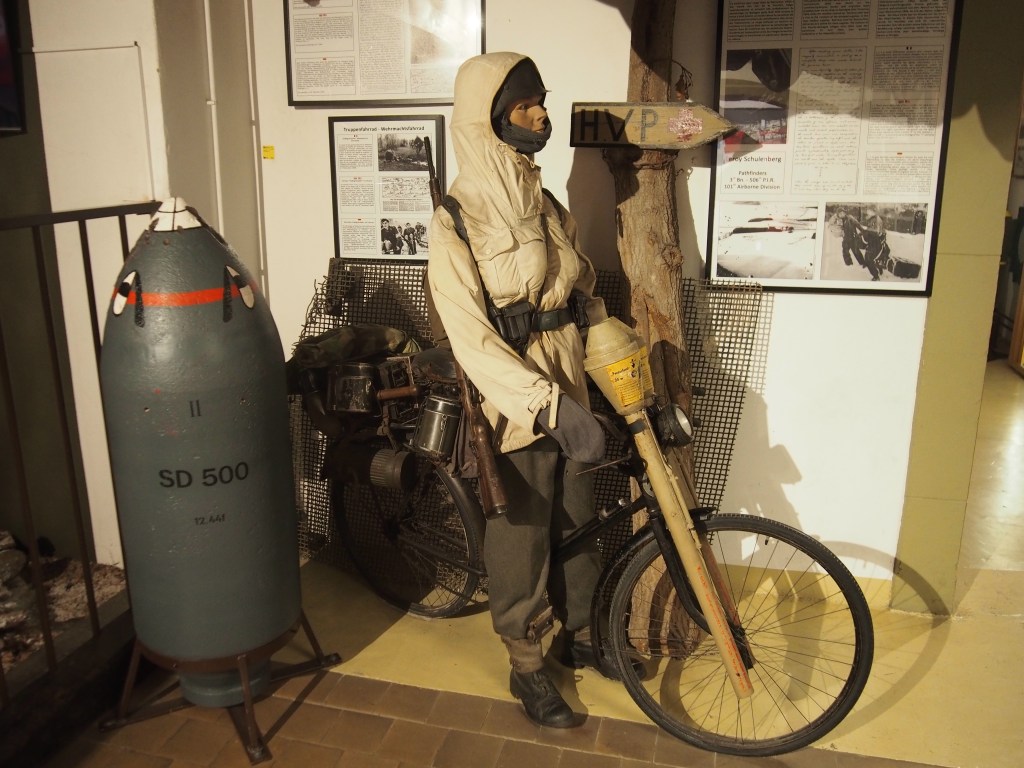
Better equipped than they probably were in real life, this mannequin is meant to represent one of the Volksturm units’ Anti-Tank elements … a guy on a bicycle with two Panzerfausts (90s or 150s, not sure which). Like the guy in Band of Brothers shouts at the German POWs marching along the centre-line of an autobahn with the occasional horse drawn waggon (from the back of a truck) … What were you thinking?
The box contains two different types of Panzerfausts — 60’s, I think, on the right, which were probably obsolete by the time of the Ardennes offensive, but still around (obviously) and the ones on the left are 150’s, I am pretty sure, which were the very latest.
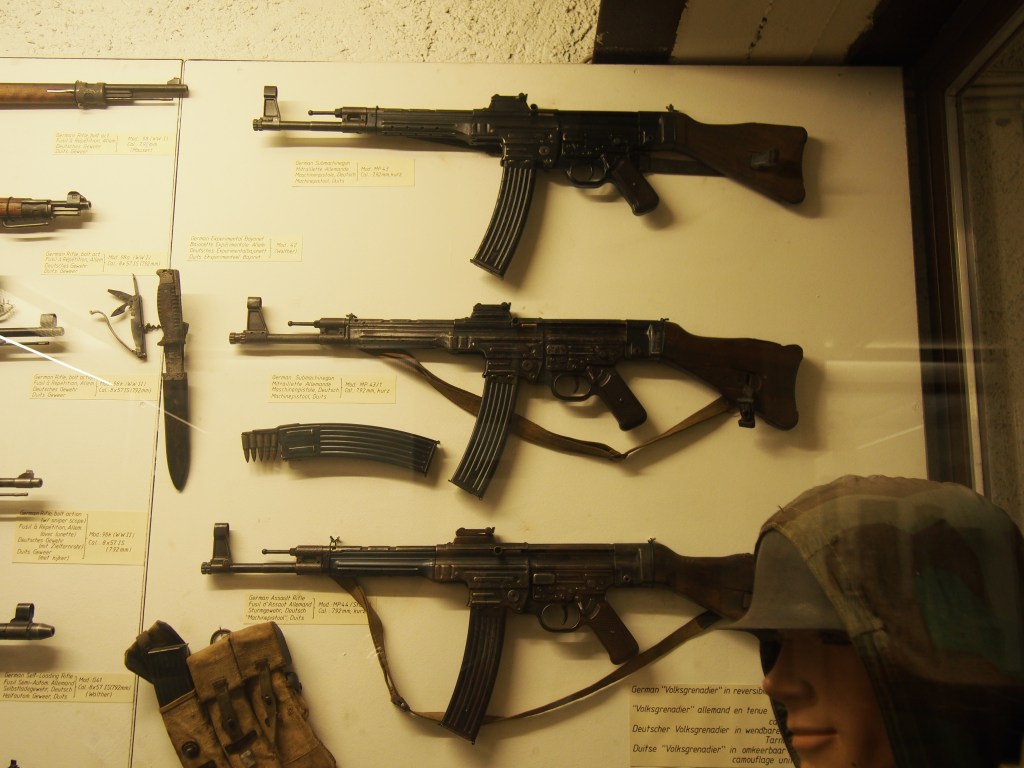
Three generations of the late war German assault rifle … from top to bottom, MP-43, MP-44, and Sturmgeschutz-44. They’re really the same basic weapon with a few minor changes to make production easier and cheaper … and very few were available. Some were, however, used by elements of the various Volksgrenadier units during the Ardennes offensive.

They have a large hall (in the process of being expanded) on one of the top levels which contains a large number of soft-skinned WW2 era vehicles (and some light armoured cars and the like) … but, well, remember what I said about things being jam packed? That was the case. For the most part you simply couldn’t get an angle that would show the whole vehicle without something else getting in the frame.

There are, however, several large items (tanks and artillery) outside at the front of the museum … see below …
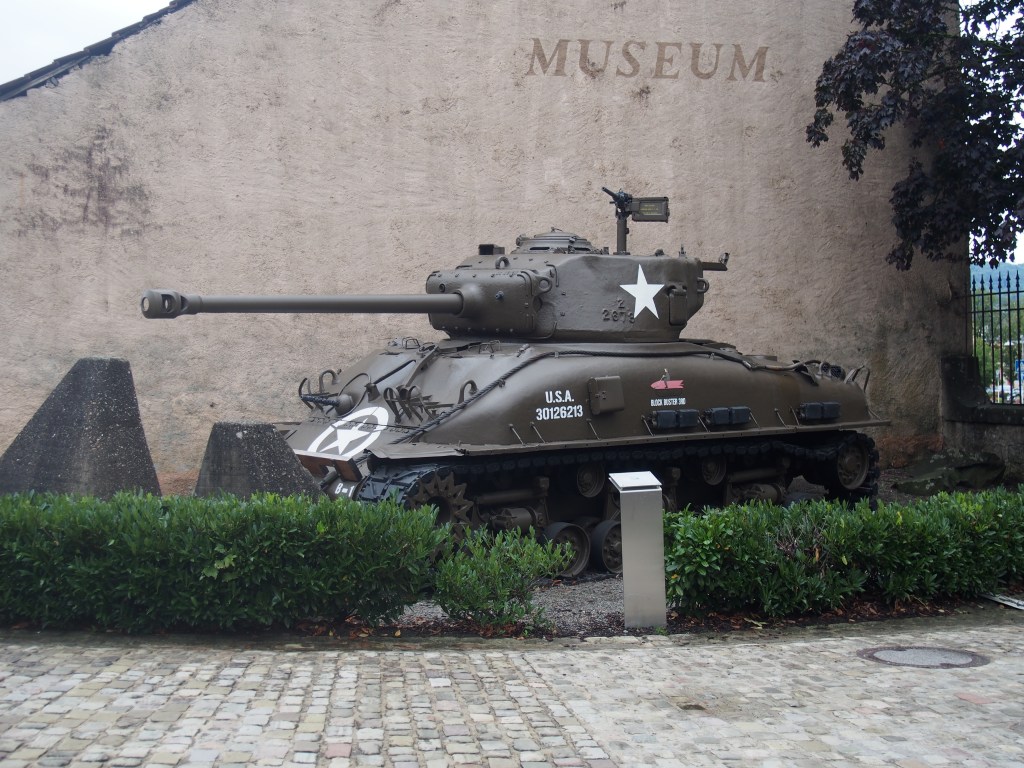
A US early model cast-hull Sherman with long 76mm gun. This sort of tank would have been used in US Armoured/Mechanised Divisions during the Bulge (this particular one wasn’t, IIRC, it’s merely representative).

Luxemburg was interesting … cheaper by far (for fuel) than Germany or Belgium since they have either no fuel tax or a much reduced one and, interestingly, open on Sundays. The place I stayed at was actually built over a huge shopping mall less than a dozen klicks from the Belgian border and not more than a half hour from the German one … and it had huge numbers of German and Belgian number plates in their parking areas, and was massively crowded inside … probably because Belgians and Germans (some of them, at least) are normal people and don’t really like having the entire country close down on Sundays … so they go to Luxemburg to shop!

Germany is like Australia was in the 1950’s, bugger all is open on Sundays … Belgium and France are like Australia in the 1960’s, there are usually limited trading hours, with supermarkets opening late (9-10) and closing way early (usually 12-1:30). Backward as all get out.

Mainz

Not a lot of things to see along the Rhine between Munich and Mainz/Trier … or not in the time I had left in Germany, so I prioritized and did a long drive up to Mainz where there is the …

Gutenberg Museum

Gutenberg was a Mainz boy – born into a wealthy family there. Need I explain why he is a rather important figure?

Unfortunately, the lighting inside the museum was absolutely piss poor and I simply couldn’t get any worthwhile photos … of the printing presses.

Still, they had quite a few … and two Gutenberg Bibles.

Museum of Ancient Seafaring

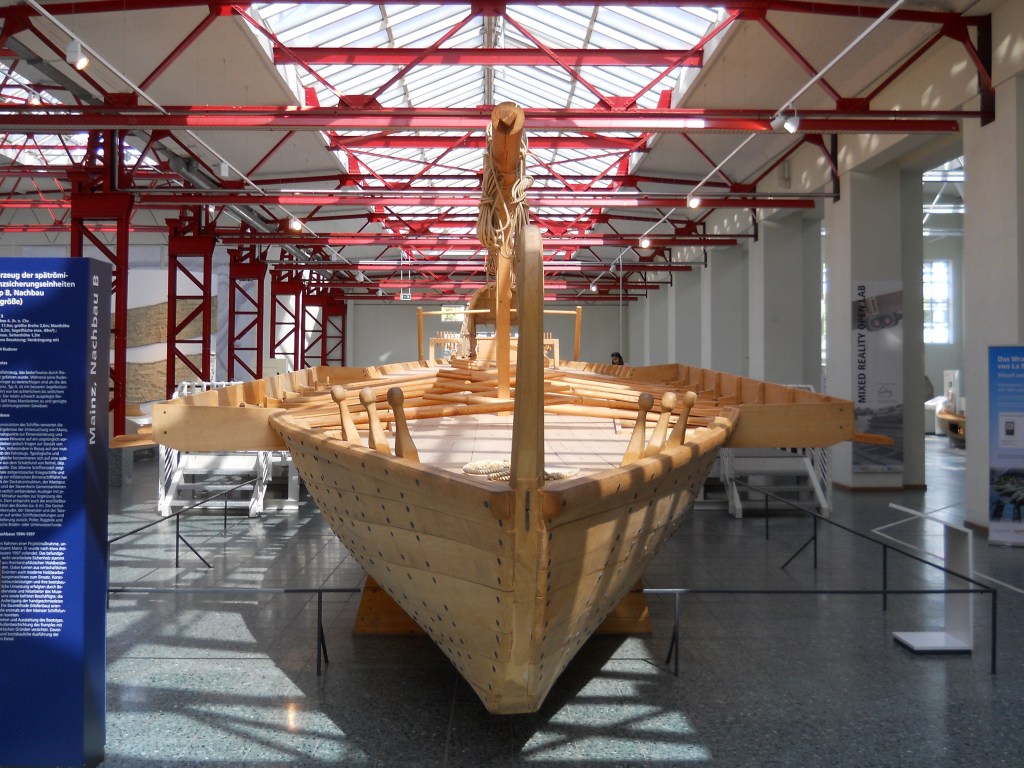
This was the unexpected sleeper … technically speaking it’s not really about seafaring so much as it is about riverine craft. Building on actual boat remains excavated at various nearby sites the museum has reconstructed actual full size replicas of several riverine craft from the Roman riverine forces as well as commercial craft.

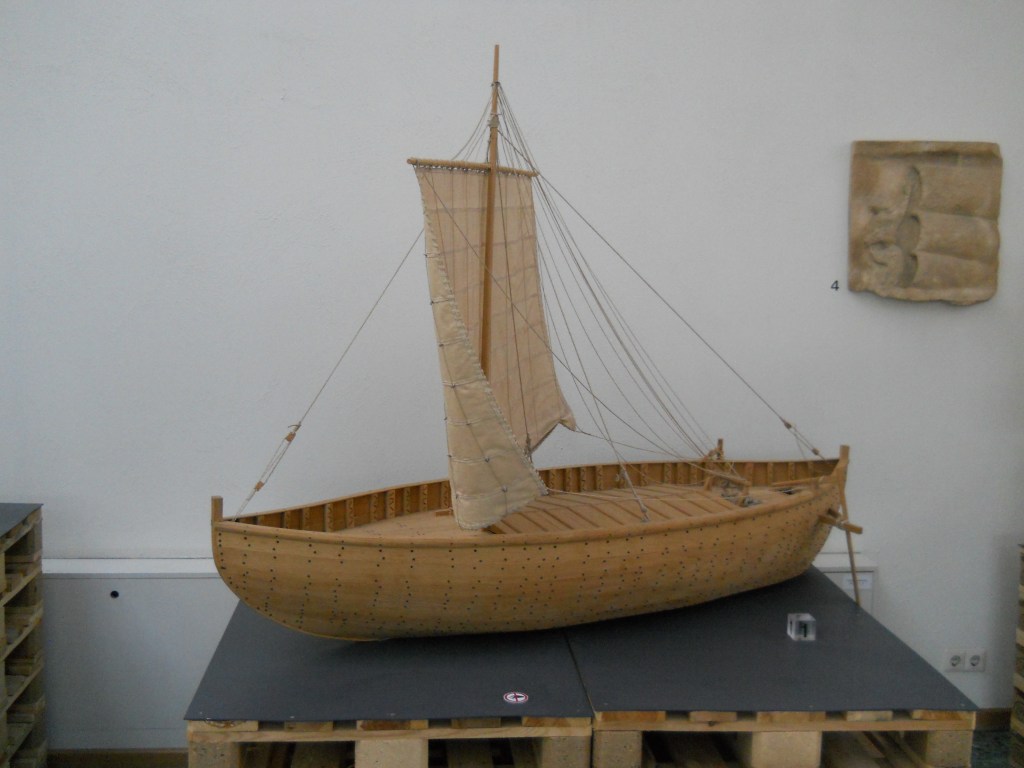
Roman riverine warship taken from above, stern. Note the steering oar and the simply rigged square sail. With such a low freeboard this would not have been the craft you’d want to actually take to sea with … heck, it’d be darned unsafe even for inshore coastal work.
Another of the reconstructed ships … this is more seaworthy and actually has a higher freeboard. It also has a typical rear ‘cabin’ … see below.
Yeah. Not much of a cabin for seagoing. But remember, Roman (and ancient ships in general) usually didn’t sail out of sight of land for long periods … they hugged the coastlines or island hopped and more often than not pulled up on shore or in a safe anchorage at night and slept on shore. For very short hops this would probably have been adequate. Notice the outriggers for the steering oar.
A Scorpion – medium tension engine (there were smaller models) usually used for throwing spear-like ‘bolts’ – they were carried into (some) battles on carts and commonly found on Roman warships or city/camp defences. They were light enough so that they may well have been left set up, but with the skeins of rope/fibre used to keep the throwing arms under tension) not twisted and under strain. Most of the time, however, they were probably stored away, disassembled and, indeed, only the metal parts may have been kept in store with the wooden parts constructed as needed to reduce transport requirements

The museum also has many dozens of wooden models of Roman and Classical era ships, ocean going (well, mediterranean going) and riverine.

A typical riverine/coastal or even north-seafaring boat of the type used by the Veneti on the Rhine.
A Roman Quinquireme – it used to be thought that these vessels had five banks of oars, based on the fact that Triremes had three – but it is now believed (as is shown here) that they only had two, but that the oars had multiple rowers … three on the lower bank and two on the upper, most likely. These large vessels were the Roman Imperial equivalent of a Battlecruiser or Battleship. There were larger vessels, but they were rarely built except in wartime, and rarely even then.
Two variants on the ‘typical’ Roman merchant ship design … some of these are known to have carried 1200 tons of grain on the Alexandria-Rome run (many days out of sight of land – an exception to the normal rule of pulling in to shore each night … and only done for around six months a year, those with the best expected weather).

Munich II

The Antiquities Museum

Being an actual Kingdom, and a pretty large one in pre-1870 terms for Germany, the Wittelsbachs (the ruling dynasty) managed to collect some nice stuff … a lot of which is in the Residenz, which I covered in my last blog post. However, they also encouraged the development of a number of major museums, including this one, which has a really nice collection of Greek, Roman and miscellaneous antiquities, mainly pottery (which wass both ubiquitous and has the fortunate property of being damn near eternal, even when broken).

Bronze Griffin heads, Greek, pre-classical.
Greek Bireme or Trireme on a wine serving dish … Black Figure ware, classical period. It’s from surviving (reconstructed from smashed bits, usually) pottery like this that we get a lot of our understanding about Greek technology, culture and society … in this case we can get details on the rigging, the shape of the sail, the shape of the bow and stern and the arrangement of the steering oars for the ship
Polychrome ware – late Classical or Alexandrian/Successor. Hairstyles, fashion, trade (the leopard skin) etc can be gleaned. It’s also pretty great art.

The Egyptian Museum

When I was in Munich last portions of what’s on display here were evidently on display in the Residenz, but not optimally … so they built a new, smallish, museum in the museum precinct to contain a much large selection of the items they have on hand … and display them much more advantageously …

A lot of what we know about Ancient Egypt’s ‘everyday life’ comes from relics found in tombs belonging to the upper classses … here we have some poor sod grinding grain into flour. The much more efficient rotary quern was not yet invented … regardless, it is estimated that it would have taken a whole morning’s work to grind enough grain into flour to bake the bread needed for a ‘typical’ family … whatever that was. Such work was, of course, mostly done by women … or slaves/servants, if you were wealthy enough to have such!
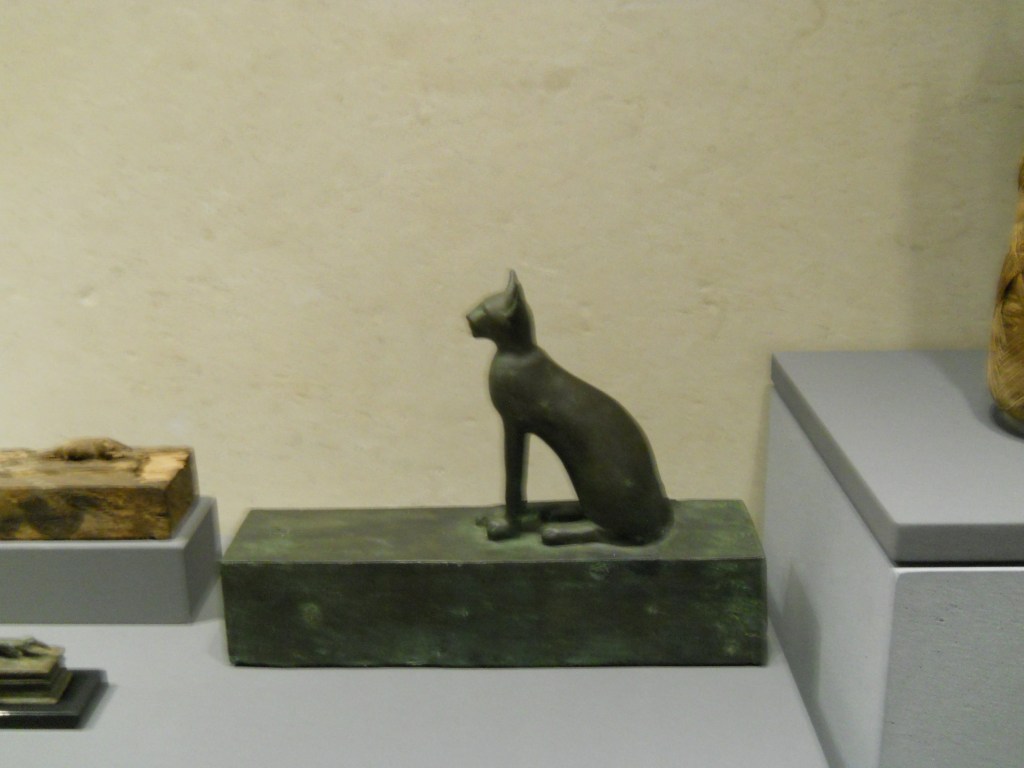
Cats were very popular – keep those bloody rodents out of your food (grain) supply. It is now thought that cats were first domesticated (actually domesticating themselves … deciding that humans were OK since they provided all those nice cat-sized rodents to snack on!) in Mesopotamia sometime after 4400 BC … the Egyptian variety, however, is a different lineage and only appears around 1500 BC … self selected for their character (aka ‘dogs have masters, cats have servants‘ … they decided humans would make their lives easier, and we did!)
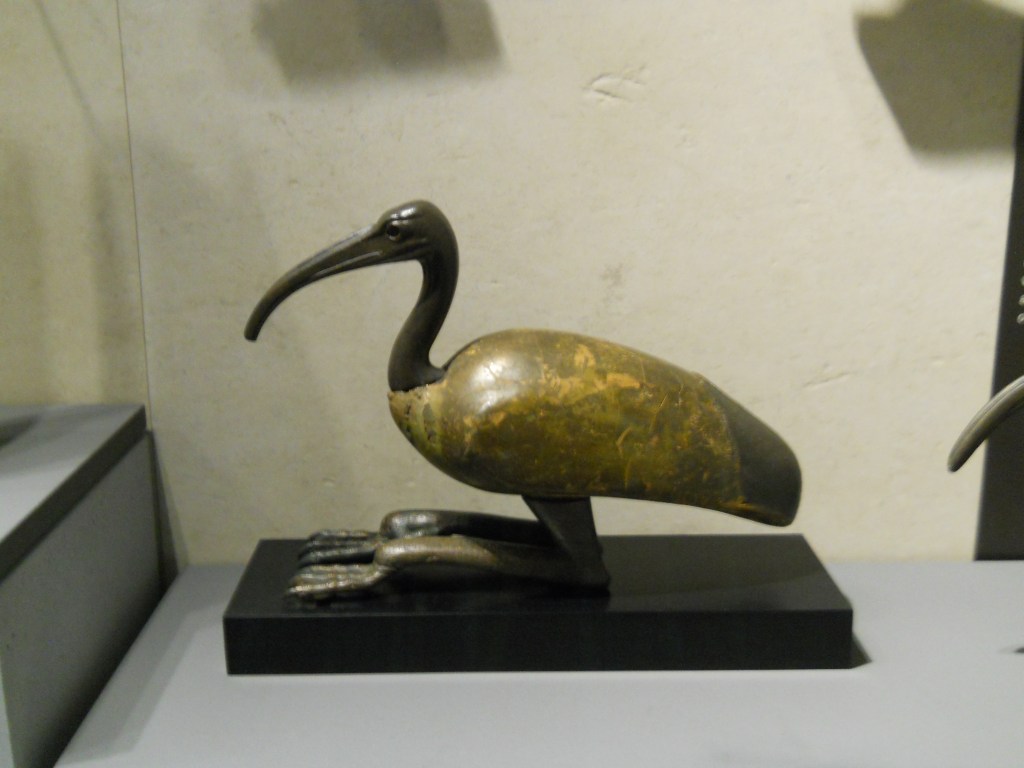
They also liked Ibises … a lot. There are tens of thousands, possibly hundreds of thousands, of mummified Ibis and Cat bodies all over Egypt. This isn’t a mummy, however, but, I think, ceramic?
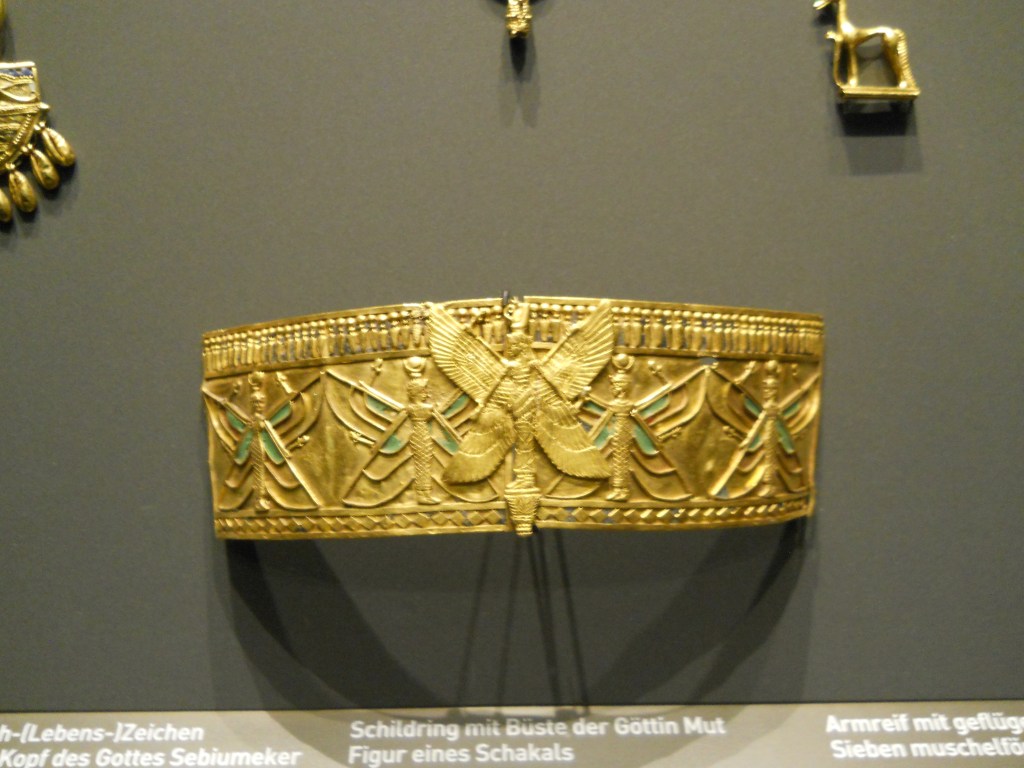
Strangely enough, the museum also has an Assyrian collection. When they were doing the original collection catalogue in the late 19th century they found they had a significant amount of Assyrian and Babylonian stuff … and it seemed to fit in best with the Egyptian stuff, so it’s remained connected ever since. Typical four winged Assyrian/Bablonian deities on a gold armband.
Another four winged deity in enamel on gold.

More tomorrow, probably of Mainz.

Munich I

Munich … the last time I was here I didn’t manage to see the Residenz (i.e. the residence of the Bavarian Dukes/Electors/Kings) … but this time I did. The Treasury is quite amazing … the things the rulers managed to pick up over the years!

The Residenz Treasury

A 10th century crown supposedly belonging to Queen/Saint Kunigunde, wife of the Holy Roman Emperor/Saint Henry II. There’s no actual evidence it ever did belong to her, of course, and the earliest mention of it is several centuries later, but the style is consistent with what would be expected of the period 901-1000 AD. Note the use of Pearls and the fact that the gemstones are polished rather than faceted.
A Portable Altar – since early medieval Noble households were peripatetic, they needed to have the necessities for performing Mass while moving around the countryside. One of those requirements was that the Host (? some physical component of the Mass) could only be rested on sanctified surfaces … hence this portable altar. The greenish stone square in the centre of the base is the blessed bit … the rest is embellishment. The gemstones remaining are all polished rather than cut.
St George slaying the Dragon – jewels, enamel, gold, silver and silver-gilt statuette on top of a reliquary supposedly holding a relic of St George. Dating to the 16th century, IIRC. Really over the top (the relic, of course, is long gone).

The Residenz Rooms

There are supposedly close to 300 rooms in the Palace, and you can visit over 200 of them … though not always the same ones. I must have had a good crack at seeing almost all that were open … here are some highlights …

The Hall of Statues/Great Hall. This is, IIRC, the largest (or very close to it, see below) room in the entire Residenz as well as one of the oldest. Though that’s evidently a bit moot as it has been extensively remodelled … partly to hold the extensive collection of greek and roman statues (or copies thereof) of one of the Dukes/Electors and partly because it was used for banqueting etc back in the day (the ceiling artwork is, of course, a later addition).
The other candidate for ‘largest room’ … much later construction, there is a throne at the end behind me. It was, of course, used for formal presentations and court functions as well as Balls and Banquets. Lots of art, even in the ceiling.
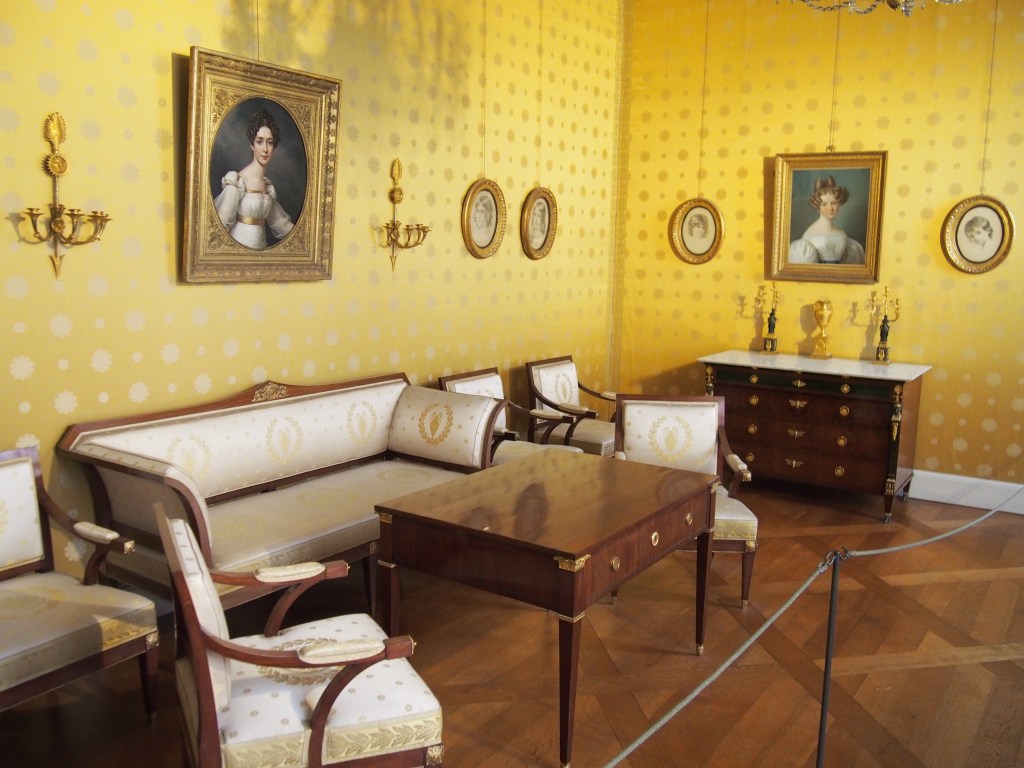
One of the early 19th century rulers was a family-loving man and preferred smaller, intimate, rooms … this was one of the family sitting rooms … the portraits are of his children.
One of the several State bedrooms – it was the fashion from the late Middle Ages through to the 18th or early 19th centuries for the local ruler to sleep in private quarters but to ‘wake up’ in a State bedroom … really meaning they simply wandered in there in their bedclothes and got in the bed to receive favoured courtiers …
Silver and Silver Gilt table service … one of several large formal table services (the other two on display were china/porcelain) used by some of the Bavarian rulers. This particular one wasn’t originally owned by them – it was sold by an impecunious noble – and it dates to the Napoleonic period.

That’s all for today, folks. More on Munich … later …